
The talks are expected to take place in the Gomel region at the Ukrainian-Belarusian border, Belta news agency reported.

India is a great power that determines its national interests and chooses its partners, Russian Foreign Minister Sergey Lavrov has said, describing as "completely unjustified" the "enormous pressure" on New Delhi due to its energy cooperation with Moscow.

When Kasturi Rajamurty won a gold medal in powerlifting at the WPPL World Cup in Russia, she sure had come a long way. From a life of penury to constantly being short of funds to fuel her passion, she had finally triumphed, and how.
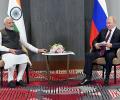
During a meeting with Putin in Samarkand, Modi had told the Russian leader that "today's era is not of war".

International oil prices retreated from an over seven-year high but was still above $100 a barrel and continue to pose threat to India's inflation rate and current account deficit. While there are no supply concerns as the oil route remained open, consumers will feel the pinch when PSU oil firms start passing on the increase in international rates through a revision in petrol and diesel prices, which have been on a pause for over three-and-a-half-months in view of elections in Uttar Pradesh and four other states. The government is "closely monitoring the situation" and will "take appropriate steps as and when required", a top official said. Brent crude oil surged past $105 per barrel on Thursday for the first time since August 2014, following Russia's invasion of Ukraine.

... and there is no stopping its pan-Islamic agenda, cautions Ambassador M K Bhadrakumar.

It is going to be a long-term proposition for India -- which has a decades-old relationship with Moscow -- to reorient its foreign policy away from Russia, the US has said, insisting that re-aligning one's approach is not like flipping a light switch.
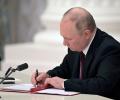
The Society for Worldwide Interbank Financial Telecommunication (SWIFT) is the world's main banking messaging service which links around 11,000 banks and institutions in more than 200 countries, including India.

Putin said the 'policy' pursued by Modi is the main 'guarantor' of relations between the two countries.

Reliance Industries Ltd on Monday reported a 5 per cent fall in the net profit for the July-September quarter, as weak oil refining and petrochemical business hurt operational performance.

Griner's lawyer Alexander Boykov told reporters they were hoping for the most lenient sentencing possible.

In retrospect, it appeared that the bitterness of the war was still strong and the Ukrainian success in occupying Russian territory just a few days ago had added to the complexity of the situation. The positive US response to the visit, however, remains a silver lining in the dark clouds, notes Ambassador T P Sreenivasan.

'The Ruble is now down 50 per cent and worth less than one American penny since Putin announced his war'
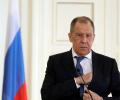
Russian Foreign Minister Sergey Lavrov will be on a two-day official visit to India from Thursday, his first trip to the country since Moscow launched its invasion of Ukraine last month.

Ukraine is currently in the middle of a strategic offensive into Russia's Kursk region.

Global brokerage firm CLSA has reversed its early tactical shift from Indian equities to Chinese stocks, and has decided to raise India allocation while cutting exposure to China. In its report titled 'Pouncing Tiger, Prevaricating Dragon', CLSA cited challenges facing Chinese markets in the aftermath of Donald Trump's victory in the US elections as the reason for the move. "Misfortune can happen in threes. So it has played out for Chinese equities over the past week.

State Bank of India, the nation's largest lender, has stopped processing transactions of Russian entities that have been sanctioned by the West over Moscow's invasion of Ukraine, sources said. To effect this, SBI has issued a circular as it fears that any transaction with entities or sectors under sanction will invite sanction on it as well, sources said. No transactions involving entities, banks, ports or vessels appearing on a US, European Union or United Nations sanctions list would be processed irrespective of the currency of the transaction, they said. Payments due to such entities have to be processed by other mechanism rather than through the banking channel, sources added.

As much as 8 billion rubles (about Rs 1,000 crore) of dividend income belonging to Indian oil firms is stuck in Russia after the Putin administration clamped down on dollar repatriation, officials said on Friday. Indian state oil firms have invested $5.46 billion in buying stakes in four different assets in Russia. These include a 49.9 per cent stake in Vankorneft oil and gas field and another 29.9 per cent in TAAS-Yuryakh Neftegazodobycha fields.

Last June, the group had delisted Essar Energy from the London Stock Exchange as well.

The Organization of the Petroleum Exporting Countries (Opec) and its partners, such as Russia, collectively termed Opec+, have decided to cut crude oil production by 100,000 barrels per day (bpd) from October onwards, at a meeting on Monday. In a step that may increase prices in India, the group has decided to reduce output quotas for October, after a fall in global oil demand outlook. The cut in output is equal to 0.1 per cent of global supply.

Lisa Curtis, who served as deputy assistant to President Trump and as National Security Council senior director for South and Central Asia from 2017 to 2021, said she expected the same bumps for India and the US, as in Trump's first term, including tariff, dependence on Russia over arms supply and oil purchase from Iran. Curtis, however, said both countries could never enter an alliance but develop a partnership that is "short of an alliance". She hoped them to achieve a cooperation that deters China, but also prepares both countries in case of a crisis or conflict, be it in the Taiwan Strait, the South China Sea, or another flare-up on the India-China border.
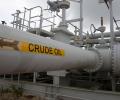
Crude oil shipments from the US to India rose to the highest levels in November since the conflict began in Ukraine in late February, sparking hopes of a resurgence in oil flows from the US to the subcontinent, reveals shipping data. Shipments from the US have surged as Western nations prepare to impose additional sanctions on Russian crude flows. The US shipped around 450,000 barrels per day of crude last month to India, twice that of shipments in October, according to data from London-based commodity intelligence provider Vortexa.

The Western world keeps talking, ratcheting up sanctions, the only thing it can do. The Russians march on to Kyiv and capture Zelensky and key members of his government as part of their 'de-Nazification' drive, predicts Shreekant Sambrani.
Abramovich handed Chelsea director control of firm on day of Ukraine invasion - filings
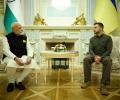
Ukraine and Russia need to engage with each other to find a solution to the ongoing conflict between them, India said on Friday after Prime Minister Narendra Modi held wide-ranging talks with President Volodymyr Zelenskyy in Kyiv under the shadow of the raging war.
Global oil prices have slumped and India has access to larger amounts of discounted Russian crude oil, yet refiners are not passing on their savings to consumers
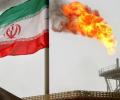
Iran has offered to help India meet its energy needs by relaunching rupee-rial trade for export of oil and gas, said Iranian ambassador to India Ali Chegeni. Chegeni said if both the countries resume rupee-rial trade, bilateral trade can touch $30 billion. Iran used to be India's second largest oil supplier but New Delhi had to halt imports after the former US president Donald Trump withdrew from the nuclear deal with Iran and re-imposed sanctions on its oil exports.

Jaishankar said he was confident that Prime Minister Modi and President Putin will meet for an annual summit next year.

India's trade deficit with Russia continued to widen for the second consecutive year to $57 billion in the financial year 2023-24 (FY24), with Moscow becoming New Delhi's largest source of crude oil imports. All eyes will now be on Prime Minister Narendra Modi's visit to Russia during July 8-9, where he is set to meet President Vladimir Putin. This will be Modi's first visit to the Kremlin since the Russia-Ukraine conflict began over two years ago.

Supporters of Imran Khan's Pakistan Tehreek-e-Insaf party protest the hike in fuel prices in Pakistan.
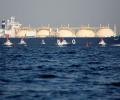
Oil and LNG prices are likely to shoot up if Iran is to block Strait of Hormuz, through which countries like India import crude oil from Saudi Arabia, Iraq and UAE, leading to a spike in inflation, analysts said on the Iran-Israel conflict. The Iran and Israel conflict has escalated over the last few days. Iran first launched drone and rocket attacks on Israel, which retaliated by firing a missile. Crude oil prices have hovered around USD 90 per barrel since the conflict.

Russia has been grappling with sanctions slapped by the US and its allies over Moscow's invasion of Crimea.

India's current account deficit (CAD) may dip further in the March quarter of FY24 as pressure from the negative net exports during the January-March period eased to an 11-quarter high. A part of the gross domestic product (GDP) data, net export- which is usually negative for India - captures the difference between exports and imports of both goods and services, while the CAD data, released by the Reserve Bank of India (RBI), also factors in private transfer receipts.

If international crude oil prices zoom past the current level of about $90 per barrel and move towards $100 and beyond, middle-class consumers are not going to keep quiet about their discomfort, points out Arun Balakrishnan, former chairman and managing director, Hindustan Petroleum.

Equity benchmarks Sensex and Nifty on Thursday gave up all early gains to settle lower as surging oil prices amid the ongoing conflict between Russia and Ukraine hit investor sentiment. The 30-share BSE Sensex started the trade on a higher note and jumped 527.72 points in morning deals to a high of 55,996.62. However, during the afternoon trade it surrendered all its early gains and finished at 55,102.68, lower by 366.22 points or 0.66 per cent.

Equity benchmarks declined on Tuesday after a three-day rally, with the Sensex falling 359.33 points amid selling in index majors HDFC, Reliance Industries and Infosys. Investors were cautious ahead of release of GDP data, while a jump in crude oil prices also weighed on market sentiment, traders said. The 30-share BSE Sensex went lower by 359.33 points or 0.64 per cent to settle at 55,566.41.

The virtual meeting between the two leaders came in the midst of some disquiet in Washington over India's position on the Ukraine crisis as well as its decision to procure discounted Russian oil.

Prime Minister Narendra Modi on Tuesday underlined the need for not promoting any restrictions on the supply of energy and called for ensuring stability while once again emphasising on resolving the Ukraine conflict through diplomacy.

Wholesale price-based inflation rate fell to a 3-year low of (-) 3.48 per cent in May on easing prices of food, fuel and manufactured items, strengthening the case for continuing with the pause in rate hike in the coming months of the current fiscal. This is the second straight month when WPI has been in the negative zone mainly on account of a higher base and falling prices of fuel and manufactured goods. Food prices also eased during May. In May, 2022 WPI inflation was at 16.63 per cent. Last month, it was (-) 0.92 per cent.
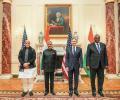
The pressure on India to take a hostile attitude towards Russia and China was not subtle, but it was guarded, observes Ambassador T P Sreenivasan after Monday's 2+2 ministerial meeting in Washington, DC.
